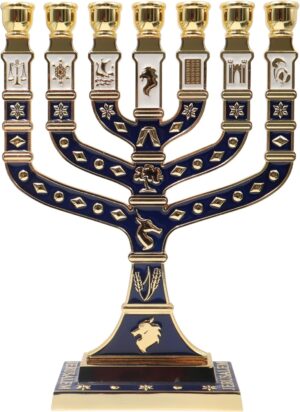
7 Branch Menorah
In the seven candle Menorah used by the Hebrew tribes in their First Temple, the seven flames represented seven spirits or the spiritual qualities that give rise to sentience. These are described in the eleventh chapter of the Book of Isaiah. Later, in the book of Revelations, the Apostle John wrote of seven flames in the throne room, with each flame said to represent one of the Spirits of God. (Excerpt- Profitable Intelligence)
Get the Menorah
Description
The Temple menorah (/məˈnɔːrə/; Biblical Hebrew: מְנוֹרָה, romanized: mənorā, Tiberian Hebrew /ˌmənoːˈʀɔː/) is a seven-branched candelabrum that is described in the Hebrew Bible and later ancient sources as having been used in the Tabernacle and the Temple in Jerusalem.
Since ancient times, it has served as a symbol representing the Jews and Judaism in both the Land of Israel and the Jewish diaspora. It became the State of Israel’s official emblem when it was founded in 1948.
According to the Hebrew Bible, the menorah was made out of pure gold, and the only source of fuel that was allowed to be used to light the lamps was fresh olive oil. The menorah was placed in the Tabernacle. Biblical tradition holds that Solomon’s Temple was home to ten menorahs, which were later plundered by the Babylonians; the Second Temple is also said to have been home to a menorah. Following the Roman destruction of Jerusalem and the Temple in 70 CE, the menorah was taken to Rome; the Arch of Titus, which still stands, depicts the menorah being carried away by the triumphant Romans along with other spoils of the destroyed temple. The menorah was reportedly taken to Carthage by the Vandals after the sacking of Rome in 455. Byzantine historian Procopius reported that the Byzantine army recovered it in 533 and brought it to Constantinople, then later returned it to Jerusalem. Many other theories have been advanced for its eventual fate, and no clear evidence of its location has been recorded since late antiquity.