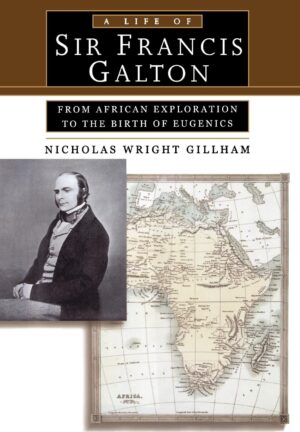
A Life of Sir Francis Galton
Developed largely by Sir Francis Galton as a method of improving the human race, eugenics was increasingly discredited as unscientific and racially biased during the 20th century, especially after forced sterilization policies were adopted in California together with thirty-one other states during the early twentieth century. (Excerpt- Profitable Intelligence)
Get the Book!
Description
Few scientists have made lasting contributions to as many fields as Francis Galton. He was an important African explorer, travel writer, and geographer. He was the meteorologist who discovered the anticyclone, a pioneer in using fingerprints to identify individuals, the inventor of regression and correlation analysis in statistics, and the founder of the eugenics movement.
Now, Nicholas Gillham paints an engaging portrait of this Victorian polymath.
The book traces Galton’s ancestry (he was the grandson of Erasmus Darwin and the cousin of Charles Darwin), upbringing, training as a medical apprentice, and experience as a Cambridge undergraduate. It recounts in colorful detail Galton’s adventures as leader of his own expedition in Namibia. Darwin was always a strong influence on his cousin and a turning point in Galton’s life was the publication of the Origin of Species. Thereafter, Galton devoted most of his life to human heredity, using then novel methods such as pedigree analysis and twin studies to argue that talent and character were inherited and that humans could be selectively bred to enhance these qualities.
To this end, he founded the eugenics movement which rapidly gained momentum early in the last century. After Galton’s death, however, eugenics took a more sinister path, as in the United States, where by 1913 sixteen states had involuntary sterilization laws, and in Germany, where the goal of racial purity was pushed to its horrific limit in the “final solution.” Galton himself, Gillham writes, would have been appalled by the extremes to which eugenics was carried.
Here then is a vibrant biography of a remarkable scientist as well as a superb portrait of science in the Victorian era.