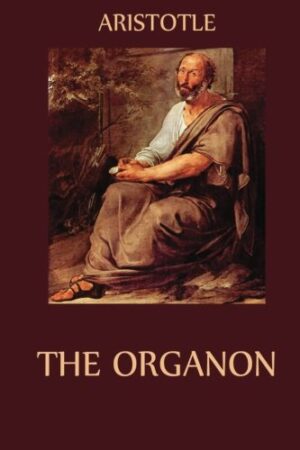
Aristotle’s Organon
The Organon is the standard collection of Aristotle’s six works on logical analysis and dialectic. The name Organon was given by Aristotle’s followers, the Peripatetics, who maintained against the Stoics that Logic was “an instrument” of Philosophy.
Description
The Organon is another name for the standard collection of Aristotle’s six works on logic. They still belong to the most significant works on this subject and were highly influential throughout history for many philosophical tendencies, especially the Scholastics.
The order of the works is not chronological (which is now hard to determine) but was deliberately chosen by Theophrastus to constitute a well-structured system. Indeed, parts of them seem to be a scheme of a lecture on logic. The arrangement of the works was made by Andronicus of Rhodes around 40 BC.
Aristotle’s Metaphysics has some points of overlap with the works making up the Organon but is not traditionally considered part of it; additionally, there are works on logic attributed, with varying degrees of plausibility, to Aristotle that were not known to the Peripatetics.
- The Categories (Latin: Categoriae) introduces Aristotle’s 10-fold classification of that which exists: substance, quantity, quality, relation, place, time, situation, condition, action, and passion.
- On Interpretation (Latin: De Interpretatione) introduces Aristotle’s conception of proposition and judgement, and the various relations between affirmative, negative, universal, and particular propositions. Aristotle discusses the square of opposition or square of Apuleius in Chapter 7 and its appendix, Chapter 8. Chapter 9 deals with the problem of future contingents.
- The Prior Analytics (Latin: Analytica Priora) introduces his syllogistic method (see term logic), argues for its correctness, and discusses inductive inference.
- The Posterior Analytics (Latin: Analytica Posteriora) deals with definition, demonstration, inductive reasoning, and scientific knowledge.
- The Topics (Latin: Topica) treats issues in constructing valid arguments in dialectic, and inference that is probable, rather than certain. It is in this treatise that Aristotle mentions the Predicables, later discussed by Porphyry and the scholastic logicians.
- On Sophistical Refutations (Latin: De Sophisticis Elenchis) gives a treatment of logical fallacies, and provides a key link to Aristotle’s tractate on rhetoric.
Whereas the Organon of the Latin Scholastic tradition comprises only the above six works, its independent reception in the Arabic medieval world saw appended to this list of works Aristotle’s Rhetoric and Poetics.